
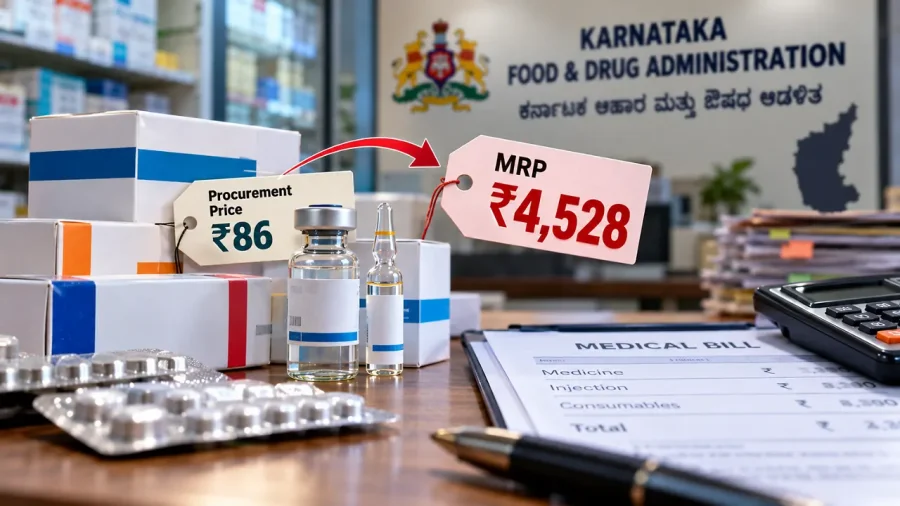
A hospital bill usually tells you what you paid. It almost never tells you what the hospital paid. In Karnataka, that gap is now the subject of a formal regulatory order.
The state's Food and Drug Administration has asked hospitals to disclose the base — or landing — price of medicines, medical devices and consumables on patient bills, according to a circular dated October 1, 2026.
What the October 1 Circular Actually Changes
The instruction is narrow on paper and significant in practice. Hospitals must now show what an item cost them before it reached the patient, alongside the MRP already printed on the bill.
That means a patient could, for the first time, see two numbers against the same strip of medicines or the same surgical consumable: what it cost the hospital, and what they were charged.
The circular covers medicines, medical devices and consumables together — a wide net that reaches everything from disposables to implants.
Why the Base Price and MRP Are Never the Same Number
The MRP printed on a medicine strip is a maximum retail price. It is not the price a hospital negotiates with a distributor, and it is not the price a patient necessarily has to pay.
Between a hospital's landed cost and the MRP sit trade margins, distribution costs, taxes and, in many cases, institutional procurement discounts that never appear on a bill.
Karnataka FDA's concern is that this space between the two numbers has stayed invisible to the person paying, with patients billed at or near MRP in several cases, as the circular notes.
How This Became a Consumer Issue in Karnataka
The order did not arrive in isolation. It follows growing scrutiny of billing practices, where the difference between acquisition cost and the price charged to a patient drew questions from regulators and patient groups.
What the circular does is convert a complaint about opacity into a documentation requirement. Instead of asking patients to trust the bill, it asks hospitals to show their working.
Who Ends Up Paying for the Silence on a Bill
For a family dealing with a long hospital stay, the effect compounds quietly. A few hundred rupees of undisclosed margin on each consumable, multiplied across days and procedures, reshapes the final figure.
Insurance policyholders are affected differently. Where a claim covers the billed amount, inflated line items feed into premiums over time. Where patients pay out of pocket — still a large share of healthcare spending in India — the difference is immediate and personal.
There is also a leverage question. A patient in a hospital bed is rarely in a position to negotiate the price of a syringe or a stent.
What the Regulator Has Said — and What It Has Not
Karnataka FDA's stated rationale is transparency: the difference in landing price and MRP, and the absence of any disclosure about actual acquisition cost, the circular says.
What the circular does not, based on available material, spell out is a compliance deadline, a prescribed bill format, or a penalty for non-compliance. Those are the details that will determine whether this remains a direction on paper or changes what patients see at discharge.
Reuters and Indian Express-style reporting on regulatory orders would normally seek comment from hospital associations and the state health department. As of the material available, no such responses have been verified.
Reading the Circular: Transparency vs Hospital Economics
Hospitals argue — as a general industry position, not a statement specific to this order — that procurement, storage, sterilisation, wastage and inventory management carry real costs, and that MRP-based billing reflects bundled service rather than pure markup.
That argument has merit in parts. But it is also an argument about service charges, and service charges belong in a separate, named line item — not embedded invisibly in the price of a medicine.
Seen that way, the Karnataka FDA order is not a price control. It is a disclosure mandate. It does not tell hospitals what to charge; it asks them to be legible about what they charged.
Confirmed Facts vs What Remains Unclear on the Karnataka FDA Order
Confirmed: the circular exists, is dated October 1, 2026, is issued by the Karnataka FDA, and directs disclosure of the base/landing price of medicines, medical devices and consumables on bills.
Confirmed: the stated trigger is the gap between landing price and MRP, and the practice of billing patients at or near MRP without acquisition-cost transparency.
Unclear: the effective date, the exact format hospitals must follow, whether the rule applies to all registered hospitals or a subset, and what happens if a hospital does not comply.
Also unconfirmed: how hospital associations have responded. Any claims about specific hospitals, specific bills or specific penalty amounts should be treated as unverified until an official document or statement surfaces.
The Wider Fight Over Medical Pricing Transparency
Drug price ceilings in India are set for scheduled formulations by the National Pharmaceutical Pricing Authority, which governs the MRP side of the equation. What has remained largely unregulated is the disclosure of what a hospital paid.
Karnataka's order pushes on that second side. If other states pick up the same language, the standard hospital bill — a document that has looked the same for decades — may start looking different across the country.
If You Get a Hospital Bill This Month, Do This
Ask for an itemised bill, not a lump-sum one. Itemisation is where the gap becomes visible, and it is the first thing a disclosure rule needs in order to mean anything.
Ask separately about the price of consumables and implants, which are often the largest and least scrutinised line items. Keep the discharge summary and bill together for insurance purposes.
If you are insured, check line items against your policy's exclusions before submitting the claim; disputes are easier to raise before settlement than after.
What Could Happen Next
The practical test is format. If hospitals publish the base price in a standard column, patients and insurers gain a reference point they have never had.
If they do not, the circular becomes another notification that changed nothing at the billing counter. The next few weeks will show which version Karnataka gets.
Our Take
This is a small order with a large idea behind it: a bill should explain itself.
Karnataka FDA has not capped anyone's earnings. It has asked for a second number — one that makes the first number defensible. In a system where patients rarely negotiate and often cannot see the arithmetic, that is a meaningful shift.
The order's value will be decided entirely by enforcement. Transparency requirements that carry no consequence tend to be absorbed quietly. The one thing patients can do in the meantime is simple: ask for the itemised bill.
Frequently Asked Questions
What has Karnataka FDA ordered hospitals to do?
The regulator has asked hospitals to disclose the base or landing price of medicines, medical devices and consumables on patient bills, in addition to the MRP already printed.
What is the difference between base price and MRP?
Base or landing price is what the hospital effectively pays to acquire the item. MRP is the maximum retail price printed on the pack. The two are rarely identical because of margins, distribution costs, taxes and procurement discounts.
Does this mean hospitals cannot charge above the base price?
No. The circular, as described, is a disclosure requirement, not a price cap. It asks hospitals to show the acquisition cost, not to restrict what they charge.
When does the order take effect, and are there penalties?
Based on the available material, no compliance date or penalty has been specified publicly. Readers should treat any claim about deadlines or fines as unverified until an official document confirms it.


