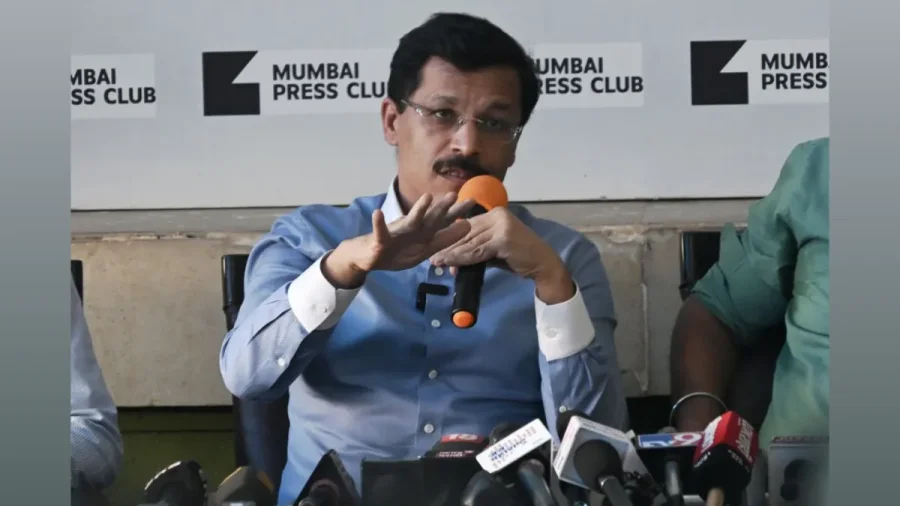
The next time a milk packet reaches a Maharashtra household, the state wants to know exactly which animal it came from. Not through a raid, a tip-off or a laboratory test — but through a digital trail that begins at the ear of the cow or buffalo that produced it.
The state's Food and Drug Administration (FDA) is preparing a tracking system that ties tagged animals to the milk they yield. Its chief, Mundhe, put the intent plainly: make adulteration harder to hide.
Maharashtra's Plan: Tag the Animal, Then Trace the Milk
Under the plan described by the FDA chief, each animal would carry an ear tag containing its details. Those details would then be matched against the milk produced from it. Where the two do not line up, the milk becomes suspect.
"Over the next few months, possibly within six months to a year, we are going to use a digital system to track it down," Mundhe said. "Every animal is tagged with an ear tag, which contains its details. If we match those details with the milk produced, I think adulteration and unsafe milk will go down."
That single sentence captures both the ambition and the limits of what has been announced so far. It is a direction of travel, not yet a notified scheme.
Why This Lands Differently in a Milk-Drinking Country
Milk is not a niche product in India. It is a daily necessity in most households, the base of tea and sweets, and the first source of protein for many children. That makes any weakness in the supply chain a public health question rather than a commercial one.
For a parent pouring a glass at breakfast, the risk is invisible. Adulteration rarely announces itself through taste or smell. That is precisely why the state is betting on data rather than inspections.
What the State Has Said It Will Do, and By When
The timeline offered is deliberately loose: a few months, possibly stretching to a year. No firm date, no phase-wise schedule and no list of districts has been made public.
What is clear is the sequence the FDA has in mind — tag first, record second, match third. Everything else, including how the system will be funded and enforced, falls into the gap between announcement and implementation.
How the System Is Meant to Work
The logic is straightforward. An ear tag gives every animal a unique identity. That identity travels with the milk as it moves from the farm to the collection centre, where the recorded output can be checked against what the animal is actually capable of producing.
A shortfall or an unexplained surplus becomes a signal. A producer whose milk volumes do not match the animals on record invites scrutiny. In theory, dilution — with water, starch or detergent — becomes much harder to carry off quietly.
What has not been explained is the technology layer underneath: whether existing animal identification records will be reused, how data will flow from village societies to the regulator, and who verifies it.
Who Stands to Gain, and Who Could Feel the Squeeze
Consumers gain most, at least in principle. So do organised dairies and cooperatives that already maintain clean supply chains — traceability rewards them rather than penalising them.
Honest small farmers with one or two animals could benefit too, because a verifiable record becomes proof of quality. The pressure lands on middlemen who pool milk from multiple sources and on anyone whose margins depend on dilution.
Why Milk Has Always Been Hard to Police
Milk is liquid, perishable and moves through many hands between the udder and the packet. Testing is sample-based and happens after the fact — a batch can be flagged only once it has already been sold.
Traditional enforcement therefore relies on raids and spot checks, which cover a fraction of the chain. A tracking system tries to move the checkpoint upstream, to where the milk is first collected.
Confirmed So Far — and What Still Needs Answers
Confirmed: the Maharashtra FDA intends to introduce a digital system to track milk, using ear tags that carry animal details, and expects it within roughly six months to a year.
Unclear: the exact start date, the budget, the districts covered first, whether tagging will be compulsory for all producers, how the unorganised sector will be brought on board, and what penalties follow a mismatch. Until those are announced, any claim about how the system will work in practice is speculation.
Risks, Costs and the Uncomfortable Questions
Traceability sounds clean in a press briefing. On the ground it raises hard questions. Who pays for tagging lakhs of animals? What happens to a small farmer whose tag is lost or damaged?
There is also the pooling problem. Milk from many animals is often mixed at a village collection centre, which can blur the link between a single tag and a single litre. Data protection is another open question, since animal records tied to a named producer are still personal information in effect.
And the biggest caveat of all: a digital system can only be as honest as the data fed into it. If records are fudged at the point of entry, the technology simply formalises the problem.
The Wider Shift: From Raids to Records
Maharashtra's move fits a broader pattern in Indian food regulation — a slow pivot from punitive inspections towards traceability, where a product can be followed backwards through the chain.
Animal identification and traceability have been gaining policy attention nationally in recent years. If that groundwork holds, a state-level milk tracking plan becomes an extension of an existing idea rather than a leap into the unknown.
What This Means for Your Kitchen
Nothing changes immediately. The system is not live, and no date has been fixed. Consumers should not read the announcement as a guarantee about the milk already in their refrigerator.
What they can do is what has always worked: buy from brands and cooperatives with a visible cold chain, check packaging and dates, and report anything that smells or tastes off to the local food safety office. Traceability strengthens the system; it does not replace vigilance.
What Happens Next
Watch for an official government notification, a pilot rollout in select districts, and any response from dairy cooperatives and farmer unions. Those three signals will show whether this stays an announcement or turns into infrastructure.
Our Take
The direction is right. India's dairy sector has long relied on trust, and trust is a poor substitute for a paper trail. Linking an animal's identity to its output is a genuinely smarter idea than random sampling, because it targets the point where dilution usually begins.
But the success of this plan will not be decided by the technology. It will be decided by whether tagging reaches the smallest producer, whether the data stays clean, and whether enforcement is even-handed rather than aimed at whoever is easiest to catch. A tracking system that burdens small farmers while leaving large-scale dilution untouched would solve the optics, not the problem.
Frequently Asked Questions
What is Maharashtra's digital milk tracking system?
It is a planned system in which every animal carries an ear tag with its details, and those details are matched against the milk produced, so that adulteration or unsafe milk can be identified and traced back to its source.
When will the milk tracking system start in Maharashtra?
According to the state FDA chief, the system will be deployed over the next few months — possibly within six months to a year. No firm date or notification has been announced yet.
How does ear tagging help reduce milk adulteration?
An ear tag gives each animal a unique identity and a record of its expected output. If milk volumes supplied do not match the animals on record, it raises a red flag, making dilution with water or other substances harder to conceal.
Will this completely stop milk adulteration in Maharashtra?
No single system can guarantee that. Digital tracking strengthens the ability to detect and trace problems, but its effectiveness depends on how widely tagging is adopted, how accurate the records are, and how consistently the rules are enforced.