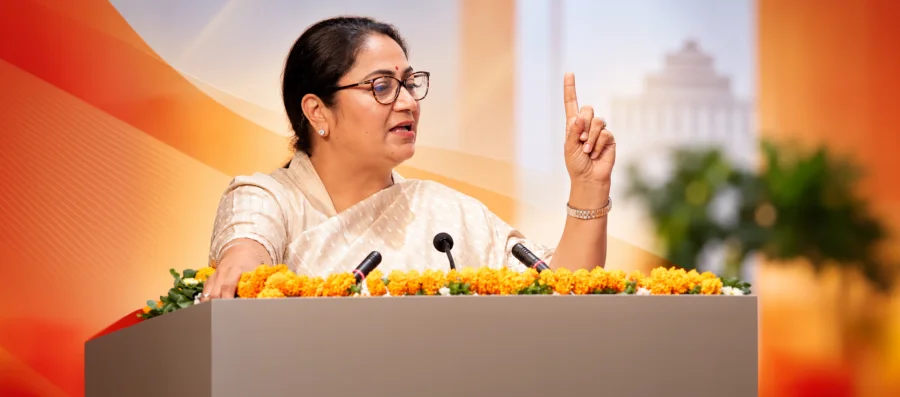
More than nine lakh people in Delhi have registered under Ayushman Bharat, and claims worth Rs 118 crore have already been paid. That is the headline number Chief Minister Rekha Gupta put out — and it lands on a city where a single hospital admission can still wipe out a month's savings.
But behind the enrolment figure sits a quieter number. Delhi currently runs around 415 Ayushman Arogya Mandirs. The stated target is 1,100.
Nine Lakh Registrations, Rs 118 Crore in Claims — What Delhi's Numbers Actually Say
According to the Chief Minister, the capital has crossed nine lakh registrations under Ayushman Bharat, with Rs 118 crore disbursed as claims so far.
She also said Jan Aushadhi outlets are now selling medicines at nearly 90% below market rates, a pitch aimed squarely at households that pay out of pocket for routine prescriptions.
The Bill You Cannot Predict Is the One That Breaks a Family
For most Delhi families, the financial risk is not a fever or a check-up. It is the sudden admission — a cardiac procedure, a fracture, a cancer diagnosis — where the bill runs into lakhs and the treatment cannot wait.
That is the gap Ayushman Bharat is designed to close: insurance-style cover for hospitalisation, paired with cheap generic medicines so that even outpatient costs stop bleeding a household dry.
Two Different Ideas Under One Brand — and Why It Confuses People
Ayushman Bharat has two distinct arms, and the Delhi update touches both.
One is the insurance side, where eligible families are enrolled and hospital claims are settled. The other is the delivery side — the Ayushman Arogya Mandirs, the upgraded primary health centres earlier branded as health and wellness centres, which handle screenings, basic treatment and referrals.
The third element the Chief Minister flagged, Jan Aushadhi stores, is a separate national push on affordable generic medicines. Read together, the three form one chain: early detection, treatment cover, and cheaper drugs.
Who Feels This First
The people most affected are the ones with the least cushion — daily-wage workers, small shopkeepers, autorickshaw drivers and families without employer-provided health cover.
For them, a working Arogya Mandir within walking distance decides whether a blood pressure problem is caught early or discovered in an emergency ward. A functioning Jan Aushadhi counter decides whether a monthly prescription costs Rs 200 or Rs 2,000.
The infrastructure gap matters precisely here. Four hundred and fifteen centres spread across Delhi's districts is a very different experience for a patient in an outer colony than for one living near a major hospital.
What the Chief Minister Said — and the Question She Left Open
Rekha Gupta presented the enrolment, claim and medicine figures as evidence that the scheme's reach in Delhi is expanding.
What was not spelled out in the available statement: how many of the nine lakh registrations have translated into actual hospital treatment, how many hospitals and nursing homes are empanelled, what the average claim per patient works out to, and how quickly the remaining Arogya Mandirs will be commissioned.
Registration is the entry gate. The payout number is the more meaningful signal of whether the system is being used.
Confirmed Numbers vs Open Questions
Verified so far, based on the Chief Minister's statement: over nine lakh registrations, Rs 118 crore in claims paid, approximately 415 Ayushman Arogya Mandirs operational against a target of 1,100, and Jan Aushadhi medicines available at nearly 90% below market rates.
Not yet established from independent sources: district-wise distribution of those centres, the empanelled hospital network, claim rejection rates, whether the 1,100 target carries a deadline, and whether the 90% price advantage applies uniformly across all medicines or to selected ones.
These are reasonable questions rather than doubts — they are simply what the public numbers do not yet answer.
Where the Pressure Points Sit: Capacity, Awareness, Uptake
The first risk is capacity. If enrolments grow faster than the number of functioning facilities and empanelled hospitals, patients will hold cover they cannot easily use.
The second is awareness. People who do not know they are eligible, or who assume the card only works at large government hospitals, often pay cash instead.
The third is perception. Launch numbers and ground-level experience frequently diverge, and a scheme judged on enrolment alone can look healthier than it is.
The Bigger Shift: Insurance Alone Was Never Going to Be Enough
Health schemes across India have slowly moved away from the idea that hospital cover alone solves the problem.
The current approach bundles three things: protection against catastrophic bills, primary care close to home, and cheaper everyday medicines. Delhi's numbers fit that pattern — insurance growth on one side, generic medicine push on the other.
Whether the model works depends less on the enrolment figure and more on how many people avoid a hospital bill altogether.
If You Live in Delhi, Here's What's Worth Doing
Check whether your household is eligible under the scheme rather than assuming you are not — eligibility is often missed, not denied.
Ask at your nearest Ayushman Arogya Mandir or government facility which hospitals accept the scheme, so that a medical emergency does not become a search for information.
For regular prescriptions, compare the Jan Aushadhi price against what you currently pay. The saving is real for many common medicines, but it varies by drug, so treat the 90% figure as an average rather than a guarantee.
What to Watch Next
The obvious markers are the pace at which the remaining Arogya Mandirs come up, and any future revision of the claim and enrolment figures.
If the number of operational centres climbs while claims continue to rise, that would suggest the network, not just the paperwork, is expanding.
Our Take
Nine lakh registrations and Rs 118 crore in claims are meaningful, but they measure demand — people wanting health cover — more than they measure delivery.
The harder test is the 415-versus-1,100 gap. A health scheme becomes genuinely useful not when people sign up, but when a family in an outer Delhi colony can find a working centre nearby and a hospital that accepts the card without argument.
That is the number Delhi should be tracking next.
Frequently Asked Questions
How many people have registered under Ayushman Bharat in Delhi?
Delhi Chief Minister Rekha Gupta said more than nine lakh registrations have been recorded in the capital, with Rs 118 crore paid in claims so far.
What is an Ayushman Arogya Mandir?
It is a primary healthcare centre — the rebranded version of what were earlier called health and wellness centres — offering basic treatment, screening and referral services close to where people live. Delhi has around 415 of them, against a target of 1,100.
Does Ayushman Bharat cover the full hospital bill?
The scheme's flagship insurance component is designed to provide annual hospitalisation cover per eligible family under its national framework. The exact amount available to a patient depends on eligibility, the treatment category and whether the hospital is empanelled. Delhi's figures released so far do not break claims down by patient or procedure.
Are Jan Aushadhi medicines really 90% cheaper?
The Chief Minister cited a figure of nearly 90% below market rates. Jan Aushadhi stores sell generic equivalents of branded medicines, and savings are usually substantial — but they differ from one medicine to another, so compare prices for your specific prescription.
How do I check if my family is eligible?
Verify your status through official government channels or at a government health facility, and confirm which nearby hospitals accept the scheme. Avoid relying on unofficial messages or forwarded lists.