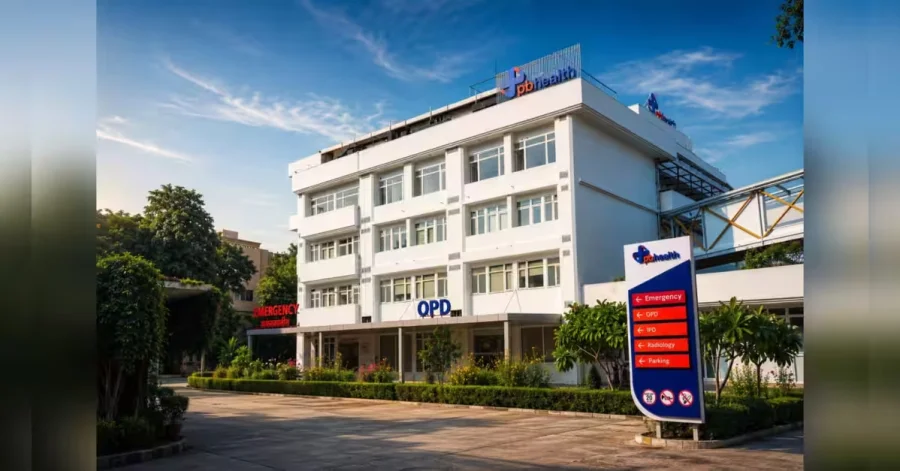
PB Health has opened its first hospital — a 100-bed multispecialty facility in Gurugram — marking the company's entry into physical healthcare delivery. For a city where patients routinely cross sectors looking for a bed, that is a small addition. For PB Health, it is the first brick in something much larger.
The company has said it wants to build a hospital network across Delhi-NCR and expand nationally through acquisitions and franchise partnerships. That single sentence is the real story here — not the 100 beds.
A 100-Bed Start in Gurugram, and an Ambition That Doesn't Match the Size
A 100-bed multispecialty hospital is a mid-sized facility by NCR standards — big enough for surgery, emergency care and inpatient treatment, small enough to be a proving ground rather than a flagship in the conventional sense.
What matters is the plan attached to it. A single hospital is an operating business. A stated intent to build a network across Delhi-NCR and then go national through acquisitions and franchise partnerships is a strategy, and strategies are harder to execute than buildings are to open.
Why the First Hospital Is a Different Business Than Whatever Came Before
Running hospital beds is capital-heavy, regulated and unforgiving. Occupancy, doctor retention, empanelment with insurers and government schemes, nursing ratios, emergency response times — each of these decides whether a hospital earns money or bleeds it.
Because PB Health has described this as its entry into physical healthcare delivery, the Gurugram facility effectively serves as its proof of concept. If the model works here, the acquisition and franchise plan has something to stand on. If it doesn't, scaling will only multiply the problem.
Acquisitions and Franchises: The Fast Route, and the One That Breaks Easiest
Buying existing hospitals brings immediate beds, doctors and local goodwill. It also brings whatever liabilities, ageing equipment and staffing disputes sit inside those assets.
Franchising is faster and far cheaper — the brand expands while partners put up the capital. The risk is equally well known: inconsistent clinical quality under one name. In healthcare, a bad franchise outcome is not a customer-service complaint. It is a patient-safety question.
Who Feels This First — and It Isn't Investors
Gurugram residents are the first test group. A new multispecialty hospital adds an option for planned surgery and, more importantly, for emergencies — the moments when distance decides outcomes.
Doctors are the second group. New hospitals compete for the same specialists, and consultants typically split time across multiple facilities. Whether PB Health's Gurugram hospital can attract and hold senior clinicians will shape its reputation faster than any marketing.
Established private chains are the third. Another organised player in NCR means pressure on consultant packages, on insurance tie-ups and eventually on pricing.
What Has Actually Been Confirmed — and What Hasn't
Confirmed: the hospital is in Gurugram, it has 100 beds, it is multispecialty, and it is PB Health's first hospital. The expansion intent — Delhi-NCR network, national growth via acquisitions and franchise partnerships — is also part of the stated plan.
Not confirmed, based on the available material: the exact opening date, the investment involved, the hospital's precise location and specialty mix, named clinical leadership, insurance and scheme empanelment status, and any approvals or timelines for the next facilities. No regulatory filing or government statement was available to independently corroborate the announcement. Readers should treat the expansion roadmap as stated intent, not a schedule.
The Business Logic: Why a Health Company Wants to Own the Beds
Owning hospital capacity changes the economics of any healthcare business. A company that controls beds keeps the patient inside its own ecosystem — diagnostics, consultations, procedures, follow-ups and repeat visits flow through one place instead of being referred out.
That is the moat in this sector, and it is not technology or branding. It is three things: trust at the point of treatment, the depth of the specialist roster, and how deeply the hospital is woven into insurer and government health-scheme networks. Brands bring a patient through the door once. Empanelment and reputation bring them back.
Scale helps in a specific, unglamorous way — procurement. Bulk buying of drugs, consumables and equipment, and centralised administration, are where large chains quietly out-earn standalone hospitals.
Where the Model Could Stumble
Hospital businesses fail for predictable reasons. Long gestation periods before a new facility turns profitable. Heavy dependence on a handful of star doctors who can leave. Regulatory scrutiny over pricing and clinical standards. A franchise partner cutting corners on staffing to protect margins.
There is also a timing question. India's private hospital sector is already crowded with well-capitalised chains that have spent years refining their playbooks. A new entrant starting at 100 beds is not competing on scale — it is competing on execution, at least for now.
And one honest caveat: the entire expansion narrative currently rests on the company's own account. Until there are filings, partnership announcements or regulatory records, the network is a plan rather than a fact.
The Wider Pattern: Private Healthcare Keeps Moving Toward Beds
PB Health's move fits a broader trend in Indian healthcare — organised players and new entrants pushing deeper into inpatient capacity rather than staying on the outpatient or digital side. Physical hospitals generate the highest revenue per patient in the chain, and they are the hardest to build.
That is precisely why they are attractive. Anything easy to replicate is easy to undercut. Beds, surgeons and trust are not.
If You Live in Gurugram or NCR, Here's What's Actually Useful to Check
Don't choose a hospital on brand recognition alone. Check whether the facility is empanelled with your insurer or with government health schemes, whether it handles the specialty you need, and whether emergency and ICU care operate round the clock.
For residents, the practical question is proximity. A hospital fifteen minutes away with the right specialists is worth more in an emergency than a better-known one across the city.
For anyone tracking this story as an investment or industry theme, wait for concrete signals — empanelments, recruitment of named senior consultants, and the first acquisition or franchise announcement. Words about expansion are cheap; signed partnerships are not.
What Comes Next for PB Health
The near-term benchmark is not how many hospitals are announced, but whether the Gurugram facility reaches stable occupancy and clinical credibility. That typically takes time, and no credible timeline has been put on record here.
If the first hospital works, the acquisition and franchise route gives PB Health a genuine path to becoming an NCR network and eventually a national one. If it doesn't, expansion will simply be a more expensive version of the same problem.
Our Take
The 100 beds are not the story. The strategy behind them is. PB Health is attempting something that looks simple on paper and is brutally difficult in practice — build one hospital well, then buy and franchise your way to scale without diluting clinical standards.
That is a legitimate ambition, and the entry into physical healthcare delivery is a real step rather than an announcement. But the expansion plan is currently unaudited by the outside world. There are no verified partnerships, no disclosed investment figures, no regulatory trail to examine.
So the fair reading is this: a genuine first move, attached to a large claim that has not yet been tested. Whether PB Health becomes a hospital network or remains a single Gurugram facility will be decided by occupancy charts and consultant rosters — not by press releases.
Frequently Asked Questions
What has PB Health opened in Gurugram?
PB Health has opened a 100-bed multispecialty hospital in Gurugram. It is the company's first hospital and marks its entry into physical healthcare delivery, as opposed to its earlier line of business.
Where does PB Health plan to expand next?
The stated plan is to build a hospital network across Delhi-NCR first, and then expand nationally through acquisitions of existing hospitals and franchise partnerships. No specific cities, timelines or deal values have been confirmed.
What is a multispecialty hospital?
A multispecialty hospital offers treatment across several medical departments — such as cardiology, orthopaedics, general surgery and internal medicine — under one roof, rather than focusing on a single specialty. It typically includes inpatient beds, operation theatres and emergency services.
Is PB Health's Gurugram hospital empanelled with insurance or government health schemes?
That has not been confirmed in the available information. If you are considering treatment there, check directly with the hospital and with your insurer or scheme administrator before admission.