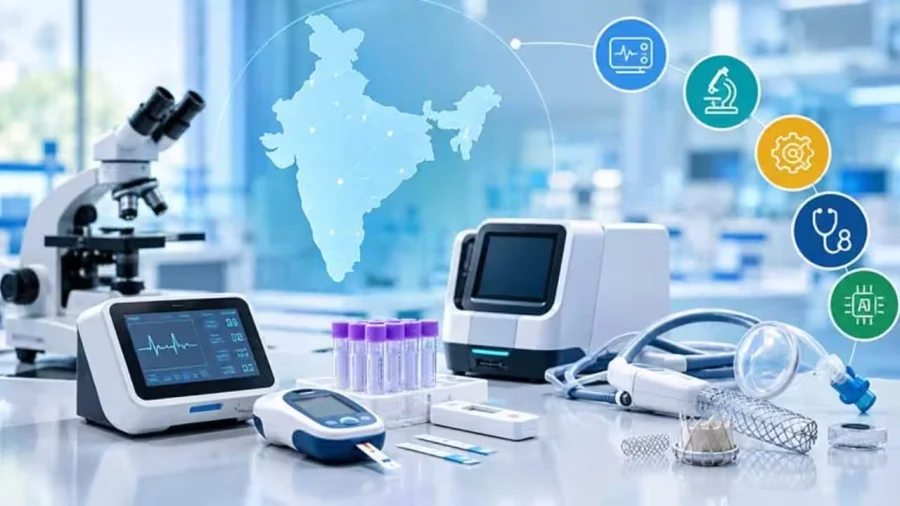
Seven campuses. Five IITs, one premier science institute, one private university. Together they now carry a mandate that could decide whether Indian hospitals one day run on machines designed and built in India — instead of waiting months for shipments from abroad.
The Indian Council of Medical Research has picked these institutions as centres to develop priority medical devices and diagnostics. The list is short, deliberate and unusually engineering-heavy. That, more than the announcement itself, is the signal worth reading.
Seven Campuses, One Mandate: What ICMR Has Actually Signalled
The selected institutions are IIT Kharagpur, IIT Delhi, IIT Bombay, IIT Kanpur, IIT Madras, IISc Bengaluru and Amrita Vishwa Vidyapeetham in Coimbatore.
Five of the seven are IITs — campuses with deep strength in materials, electronics, mechanical design and instrumentation. IISc brings fundamental science capability. Amrita adds a health-sciences ecosystem alongside engineering, which matters when a prototype has to survive contact with real patients.
In effect, ICMR has chosen a small, high-capability network over a broad, shallow one. The bet is on concentrated expertise producing usable technology faster.
Why Device Manufacturing Is India's Quiet Pressure Point
For years, India's dependence on imported medical equipment has been a recurring concern in health policy circles — not just about cost, but about control. When a critical machine or test kit comes from elsewhere, supply shocks, price swings and geopolitical disruption travel straight into the hospital ward.
Diagnostics compound the problem. A country that cannot make its own testing platforms at scale is slower to respond in an outbreak and more expensive to run in routine care.
That is the backdrop against which this selection should be read. It is a capacity-building move aimed at the long game, not a short-term procurement fix.
How the Selection Fits Into a Longer Institutional Push
India's research establishment has gradually been nudging engineering institutions toward health technology — where clinicians define the problem and engineers build the answer.
What is notable here is the composition. A medical research council selecting predominantly technology institutes suggests the priority is translation: turning laboratory work into devices that can be manufactured, tested and deployed.
Details of the selection process, evaluation criteria and the specific device categories have not been laid out publicly in the available material. That gap matters, because the categories chosen will determine who benefits and how soon.
Who Feels This First — Patients, Startups and Smaller Hospitals
The immediate beneficiaries are not patients. They are researchers who now have an institutional mandate, and the PhD students and post-doctoral fellows who will do the bench work.
Next in line are medical device startups, which often struggle not with ideas but with validation — access to testing facilities, clinical feedback and credible certification pathways. Formal centres can become that bridge.
The long-term winner, if this works, is the patient in a district hospital paying out of pocket for a test that could have been cheaper and faster if made locally.
What the Institutions Bring — and the Accountability Question
Each named campus has an existing research base: instrumentation, biomedical engineering, signal processing, materials and manufacturing. The mandate lets them organise that capability around national health priorities rather than purely academic ones.
The harder question is accountability. Designation alone changes nothing. What converts a centre into output is measurable milestones — a working prototype, a validation study, a regulatory submission, a licensing deal with a manufacturer.
None of those milestones are public yet. Until they are, this remains a promising structure rather than a proven one.
What "Priority Devices" Really Means
In health policy language, "priority" usually refers to tools where need is high, imports are heavy and the technology is achievable domestically — not the most advanced imaging systems, but the instruments that hospitals use every single day.
The exact list matters enormously. A push toward low-cost diagnostics, monitoring equipment or point-of-care testing would touch far more lives than a single high-end machine.
Until ICMR publishes the specifics, any claim about which devices are being built is speculation, not fact.
Confirmed Facts vs What Remains Unclear
Confirmed: Seven institutions have been selected — the five IITs listed above, IISc Bengaluru and Amrita Vishwa Vidyapeetham, Coimbatore. Their mandate covers priority medical devices and diagnostics.
Not confirmed: the budget, the duration, the specific device categories, the funding split between institutions, the role of private industry, and how regulatory approval will be handled. Any figure circulating without an official source should be treated cautiously.
That distinction is not a technicality. In Indian science policy, the gap between announcement and delivery is where most programmes are won or lost.
Risks and the Balanced View
The optimistic reading: concentrated expertise, a national mandate and a clear problem to solve. This is how countries build domestic capability.
The sceptical reading is just as legitimate. India has a long history of well-intentioned research programmes that produced papers rather than products. Academic incentives reward publication, not commercialisation. Device development requires clinical trials, quality systems and manufacturing partners — none of which are natural strengths of an engineering department.
There is also a concentration risk. Seven institutions cannot cover every region or every disease burden. If the network stays closed, smaller institutions with good ideas remain outside the tent.
The Wider Pattern: Building Health Technology at Home
This fits a broader global shift. Countries that once accepted import dependence for medical technology are now trying to shorten their supply chains — partly for cost, partly for resilience after recent public health shocks.
For India, the ambition is bigger than self-reliance. A credible domestic device industry is an export story, a jobs story and a public health story at the same time.
The centres are the first step in that chain. Manufacturing, certification and hospital adoption are the harder steps that follow.
Practical Guidance: What Stakeholders Should Watch
Researchers and students: watch for calls for proposals, PhD positions and collaborative projects attached to these centres.
Startups and manufacturers: the value here is partnership — testing access, clinical validation and credibility. Position early.
Clinicians: get involved at the problem-definition stage. Devices designed without clinician input tend to fail at the bedside.
Investors: treat this as a long-horizon signal, not a near-term catalyst. Commercialisation cycles in medical devices are measured in years.
Future Outlook
The next visible markers will be the publication of the specific device and diagnostic categories, the funding and governance structure, and industry engagement. After that, look for prototype disclosures and regulatory filings.
Success will not be measured by the number of centres named. It will be measured by devices that reach hospitals, pass regulatory scrutiny and outcompete imports on cost and reliability.
Our Take
This is a sensible structural move. Choosing a handful of strong institutions and giving them a national problem to solve is more likely to produce results than spreading resources thin across dozens of projects.
But designation is the easy part. India's medical device ambitions will be decided by whether these centres can do the unglamorous work — validation, documentation, regulatory compliance and partnership with manufacturers.
If they can, this list of seven will look, in hindsight, like the moment the country started taking its own medical technology seriously. If they cannot, it will read like another promising announcement that never left the laboratory.
Frequently Asked Questions
Which institutions has ICMR selected?
Seven: IIT Kharagpur, IIT Delhi, IIT Bombay, IIT Kanpur, IIT Madras, the Indian Institute of Science (IISc) Bengaluru, and Amrita Vishwa Vidyapeetham, Coimbatore.
What are these centres supposed to develop?
Priority medical devices and diagnostics. The specific device categories have not been detailed in the available announcement, so any list circulating now is unverified.
Why were technology institutes chosen instead of medical colleges?
Because device development is fundamentally an engineering challenge. Medical research councils typically define the clinical need; engineering institutions build the hardware. Selecting predominantly technical campuses points to a translation-focused approach.
What does this mean for ordinary patients?
Nothing immediate. The impact, if the programme delivers, would come over the coming years through cheaper, more available diagnostic and treatment equipment — and reduced dependence on imported devices.
Is there a budget or timeline?
Not in the material available. Budgets, timelines and deliverables have not been publicly detailed, and should not be assumed.